£0.00
Available
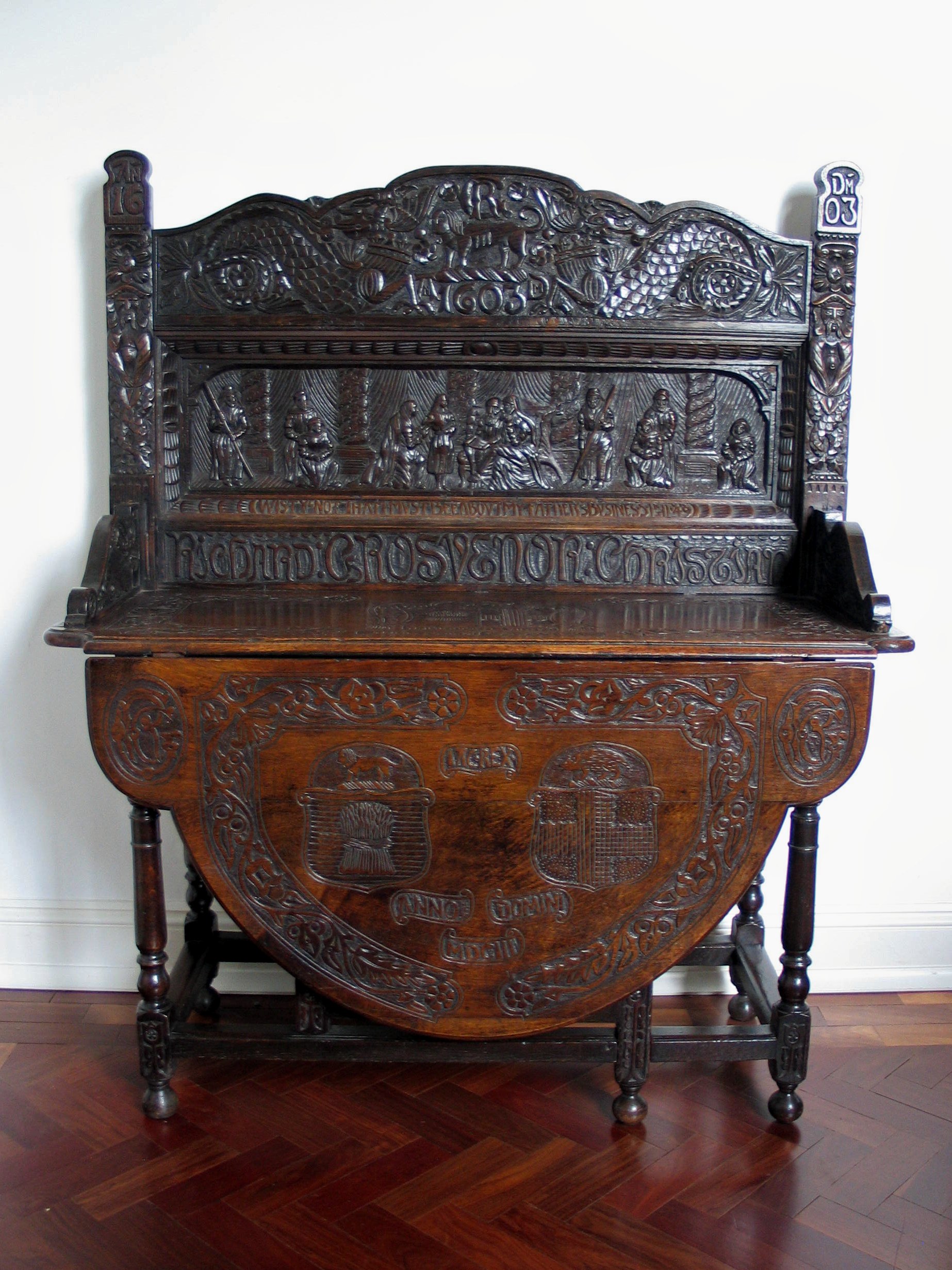
The Grosvenor Family "Marriage/Presentation" Table
A superb, unique & important Oak "Marriage" or "Presentation" Table dating from the 17th Century and believed to be a table specifically made to commemorate the marriage or family of Richard Grosvenor (b. Jan 1561/62 - d. 18th Sept 1619) and Christian, (otherwise known as "Christiana") the daughter of Sir Richard Brooke (of Norton Priory) & Christian Carew in 1584/85).
The solid frieze-back to the table is monogrammed and dated 1603. It is profusely carved with dragons and mermen caryatids and is centred by an early and well carved relief panel, inset and depicting a "biblical" scene of a young man standing before his elders in a Temple setting, this whole panel being set within a Lambrequin border. An appropiate passage for a man of such standing and ancestry, taken from the Bible (Luke II), is carved below - "Wist ye not that I must be about my Fathers Business".
The solid frieze-back to the table is monogrammed and dated 1603. It is profusely carved with dragons and mermen caryatids and is centred by an early and well carved relief panel, inset and depicting a "biblical" scene of a young man standing before his elders in a Temple setting, this whole panel being set within a Lambrequin border. An appropiate passage for a man of such standing and ancestry, taken from the Bible (Luke II), is carved below - "Wist ye not that I must be about my Fathers Business".
The single flap, gateleg table has a planked top and is also profusely and well carved displaying the two family crests, which then centrally merge into one, with further monograms, dates and carvings to the sides and surrounding area.
The top is raised and supported on a turned and block undertier and single pull-out gateleg, all of which are united by stretchers, with turned and carved supports, terminating in bun feet.
The whole has excellent colour, patination and is in good order and condition throughout. In short it is,in our opinion, a truly magnificent, historic and unique piece of furniture - undoubtedly a "showstopper" and a conversation piece in its own right.
The top is raised and supported on a turned and block undertier and single pull-out gateleg, all of which are united by stretchers, with turned and carved supports, terminating in bun feet.
The whole has excellent colour, patination and is in good order and condition throughout. In short it is,in our opinion, a truly magnificent, historic and unique piece of furniture - undoubtedly a "showstopper" and a conversation piece in its own right.
Approx Size: Ht.55 ins x L.46.5 ins x D. 18 ins closed / 39 ins open ( 140 cms x 118cms x 46 cms / 99cms)
Price: POA
_________________________________________________________
Historic Notes appertaining to the Grosvenor Family.
From the Middle Ages the Grosvenor Family was (and continues to be today) an important, wealthy and well known, respected historic Family whose origins can certainly be traced back to the 14th Century and beyond. In fact it is reported that the Grosvenor family descended from Gilbert le Grosveneur who was a relative to King William the Conqueror and accompanied him when he came over to England from Normandy, France in 1066.
The Grosvenor family name became well known in the middle ages when, albeit unsuccessfully, it disputed the right to the Coat of Arms "Azure a Bend Or" with the then more prominent "Scrope" Family in the celebrated, much publicised and renowned case of Scrope -v- Grosvenor (1385 - 1390).
The Grosvenor family inherited Eaton Hall in Cheshire in 1443 when Raufe Grosvenor of Hulme married Joan, the heiress of the Eaton Estate and this became their Country seat.
"Richard Grosvenor of Eaton" married Christian (otherwise called Christiana) (b. circa 1548 and d. Nov 1610) the daughter of Sir Richard Brooke of Norton Priory,England in or around 1584/85. Before her death in 1610 she and Richard were the natural parents of a large number of children (some 17 in total) including Richard Grosvenor born 9th Jan 1585. He was educated at Oxford graduating with a BA on 30th June 1602 and subsequently was knighted in Vale Royal on 24th August 1617 and created 1st Baronet in (February)1622 by King James 1.
It is recorded that Sir Richard Grosvenor, 1st Baronet, spent some 10 years in a debtors cell in Fleet Prison after gauranteeing loans of his "spend thrift" brother Thomas Grosvenor which went unpaid and/or for standing Surety for debts of his brother in law Peter Daniell. He married three times during his life and died in Eaton Hall in 1645 . He is buried in St Marys Church, Eccleston and was succeded to the baronetcy by his Son Sir Richard Grosvenor, 2nd Baronet.
During his life Sir Richard was a celebrated Member of Parliament for Cheshire (elected in 1621) and it has been said that his meticulous note or diary taking represents some of the most complete accounts of Parliamentary debate of the period. His said Son and heir, also called Richard ( Sir Richard Grosvenor), was the 2nd Baronet and fought along side the Royalists during the Civil War.
The Family's immense and legendary wealth appears to have come about primarily from ownership and investment in the mines and minerals in North Wales and subsequently, in 1677, when Sir Thomas Grosvenor (Son of Sir Richard Grosvenor) married Mary Davies, who was the heiress of some 500 acres of rural land on the then outskirts of London. As London grew, this land developed into the fashionable (and wealthy) areas of Mayfair, Belgravia and Westminster that we know today.
Other Members of the well known and highly distinguished "Grosvenor Family" through the years were Sir Thomas Grosvenor, 3rd Baronet (1656 -1700), Sir Richard Grosvenor 4th Baronet (1689 - 1732), Sir Thomas Grosvenor 5th Baronet (1693 -1733), Sir Robert Grosvenor 6th Baronet (d. 1755) and Sir Richard Grosvenor, 7th Baronet (1731 - 1802) the latter named being also created Baron Grosvenor in 1761 and Earl Grosvenor in 1784 by George 111 when Richard became vested with the title Viscount Belgrave and Earl Grosvenor. before becoming the 2nd Marquess of Westminster (1795 -1869).
The title 1st Marquess of Westminster" was later bestowed upon Robert Grosvenor,(1767 - 1845) the 2nd Earl Grosvenor, at the Coronation of William IV in 1831 with Richard Grosvenor subsequently becoming the 2nd Marquess of Westminster (1795 -1869)
In 1874 Queen Victoria created and bestowed the title of the "Duke of Westminster" upon Richard Grosvenor, the then 3rd Marquess of Westminster - such title deriving directly from Westminster.
In 1874 Queen Victoria created and bestowed the title of the "Duke of Westminster" upon Richard Grosvenor, the then 3rd Marquess of Westminster - such title deriving directly from Westminster.
Without doubt the Grosvenor Family have had a long and illustrious history and continue to be one of the wealthiest Landowners of modern day. Indeed many historic buildings, roads and squares in and around Westminste, Central London and beyond proudly carry the Grosvenor family name and title and the names of those connected, such as "Grosvenor Square", "Grosvenor House", "Grosvenor Hotel", and "Belgrave Square" to name but a few.
Much of the Grosvenor Estate is now held and controlled by the Grosvenor Group, a holding and managing Company whilst the main Country seat of the Grosvenor Family remains "Eaton Hall" in Cheshire, the current magnficent Hall, Chapel and Court yard having more latterly been designed and built in Victorian times by Robert Grosvenor's Grandson, Hugh Lupus Grosvenor (1825 - 1899)and which is visited by thousands each year.